Sunday, September 21, 2008

Womens Nipple Tattoos

YashicaMat 124G

dint make mumuse with dandruff, you want to have anything other than the traditional perforated films 35mm (format 135), for example (chronological classic) format 120 : rolls 6cm wide. For that, it is still necessary to have a camera that uses this format, knowing that the legendary Hasselblad are certainly excellent, but expensive, even very old and used, and most of Kodak Brownies found in the flea markets are totally unusable.

A good compromise: the camera reflex twin goals. The most famous in this genre is the Rolleiflex, but again, it costs a crazy price, even used. A little less insane than Blad, but crazy nonetheless, when we have casual use. So, it's on a device relatively new, and manufacturing in Japan, the YashicaMat 124G.

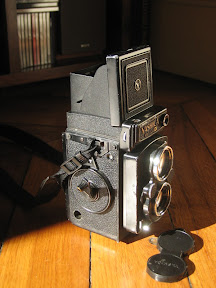
  • Type: SLR 6 × 6 to twin objectives
  • Manufacturer: Yashica
  • Model: YashicaMat 124G
  • Year of manufacture: 1971 - ?
  • Purchase Date: October 21, 2007

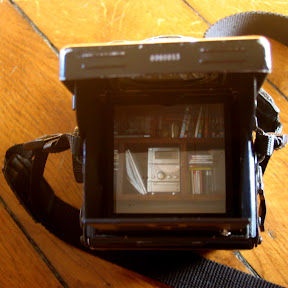
The principle of these devices: the two objectives have a formula Optical identical and are set to the same front moves and which moves forward or backward to complete the development. The top one allows targeting, through a mirror and a frosted one looks at the top (see third photo). The lower one is facing the film, it was through him that is shooting. It has the advantage of focusing directly, constantly on the frosted the sharpness of the image, without the need for a telemetry system, without the disadvantage of a movable mirror, mechanically sensitive ( especially as the mirror is larger than 35mm).

The goal is not interchangeable shutter it is integrated, it is a radial valve located at the focal point of the lens, not a horizontal or vertical curtain located at the focal plane, ie just before the film. Advantage: the focal point, as its name suggests, the light corresponding to the image is almost together at one point, the opening and closing the shutter is simultaneous for all the image.

On a 35mm case, however, the opening of the image is shifted in time by following the path of the curtain - even if the entire image receives the same amount of light because the second curtain (which ", closes the window") moves in the same direction as the first. The exhibition is just shifted in time from one end to another image, a few fractions of seconds. It's trivial for pictures in natural light, by cons for the flash picture is more annoying: the flash is anyway much shorter than the opening time of shutter must ensure that the first curtain is finished and open the second has not begun to close when it starts Lightning - otherwise a part of the photo is taken with flash and one without. At high speeds, close the second curtain starts before the first has finished open: no flash picture possible. We must therefore follow an exposure time limit for the camera flash, this is called speed flash sync (between 1 / 60 and 1/125th following boxes).

On radial valve housings, therefore, no problem: you can take pictures with flash at any speed, which is interesting when using the flash as a supplement and not as the sole source of light.

addition to these theoretical advantages, the device is YashicaMat most sympathetic side of the crank film advance (see photo 2) is a bit noisy and not very convenient, but deliciously retro. It has a photocell (the small circle above objectives, the first picture), but on mine like many of her contemporaries, she no longer works. The lens is also of excellent quality, enjoying the same treatment as that of multilayer casings 35mm from the same period. I owe him the coup some pictures which I am relying more r: is not it ultimately the best argument that can be given for a camera?

Monday, September 8, 2008

Where To Find Katydid

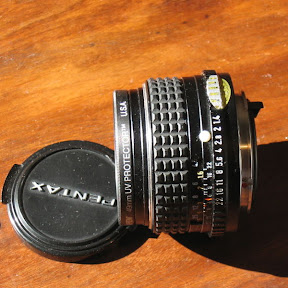
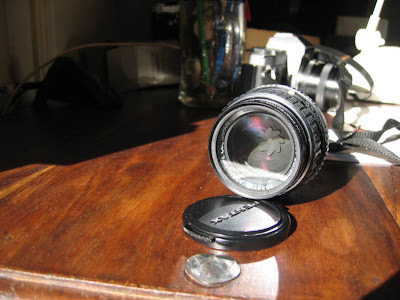
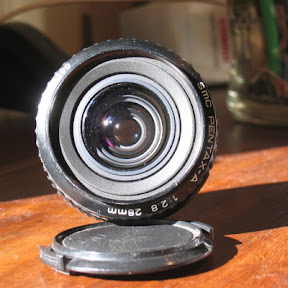
SMC Pentax-A 28mm f:2.8

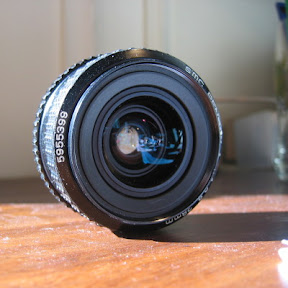
Although I tend more toward the telephoto Avoi some great angles do peuit not hurt. I came across this little 28mm by chance on the bay. Not too expensive, and more SMC Pentax-A, non-M, which does not spoil anything.


  • Type: fixed lens, manual focus and iris automated
  • Manufacturer: Pentax
  • Model: SMC Pentax-A 28mm f: 2.8
  • Purchase Date: September 27, 2007
  • filter holder: 49mm
  • Aperture: f/2.8 to 22, five blades
  • Focus: 30cm to infinity

So why A ? That's automatic simply: the diaphragm of the lens can be set directly by the housing, without user intervention. If the box has a program mode, it will even automatically adjust the aperture and shutter speed, depending on available light and sound or its programs.

Specifically, what's the difference? Unlike the F-Pentax lenses, there is no integrated electronics, and mechanical couplings are very close to those goals Pentax-M. But not quite ...

First, there are a number of electrical contacts that allow the case to know the characteristics of the target. Objective side, in fact, there is not actually contact the contrary, a small plastic pellet is at the location of some of the switches used for housing insulation, for others, contact is established by the metal frame. These contacts or absence of contact can encode openings maximum and minimum diaphragm history that the case does not ask the impossible.

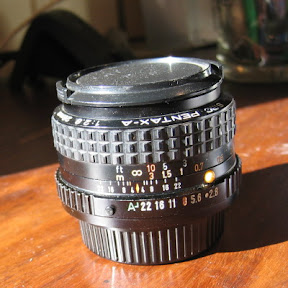
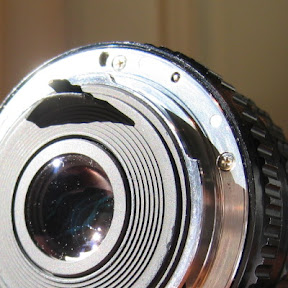
An additional contact is a bit unusual, distinguished on the fourth picture, roughly halfway between the two screws on the frame. It corresponds to the A position marked on the aperture ring (see third picture) and when this position is chosen, this little metal point juts slightly, making contact which means the case that one wishes to use the auto iris. Note that if the case does not use these contacts, the target behaves almost as an objective of the series Mr.

A more subtle differences: all mount lenses K have two mechanical couplers. One relays in case the position of the aperture ring and the second blocks the diaphragm in the open position to develop and adjust speed and aperture while keeping the lens wide open, which is much more convenient . Simply, the case made its claculs taking into account the width of the diaphragm when it is closed, information provided by the first coupler; when it starts shooting, the second coupler recedes, leaving the diaphragm closed.

On the objectives of series A, the second coupler is slightly modified its mode of action is more precise and carefully calibrated (the small bitonnieau metal visible on the top of the frame on the fourth photo). Result: while for the goals of K-series or M, his action was an all or nothing (keep the iris open, or back completely so that it closes at the selected position on the ring), with the objectives A, the case can not roll back the coupler only partially, leaving the diaphragm close, but only chosen by opening the housing. This is how the opening is chosen.

course, on my boxes ME Super or MX, it makes me look good: these packages do not have the ability to control the diaphragm and a M series lens would have given exactly the same result . For cons, the P30T (which I am separated from) the MZ-10 MZ- and 5n have this capability, and the Pentax digital SLR cameras as well, which is seriously taken up the series lenses A!

Sunday, August 31, 2008

Toter Trash Cans Wheree Do You Buy

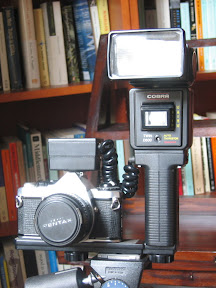
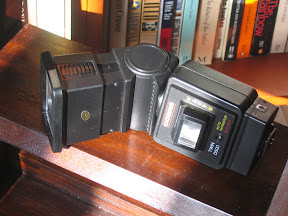
Flash Cobra D500 Dedicated + Pro Grip

I was not and am still not a big flash pros; long, I only used the flash, plus Sunpak where it was not enough. Never had very good results with this flash, so I had decided to buy something else ...

  • type electronic flash to TTL or autonomous, manual zoom and tilt and swivel head with extra flash front
  • Manufacturer: Cobra
  • Model: Cobra Twin D500 module Pentax
  • Guide Number: 30m focal length averaged 100 ASA
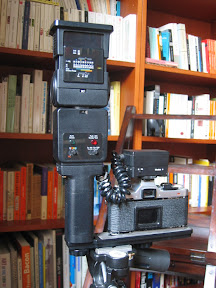
  • Accessories: pro-grip and bracket for remote mounting (see picture), color filters
  • Purchase Date ;: September 26, 2007.

A purchase of the bay, in its British version, a disappointment if the animal is friendly at first, it is also a construction very robust. She had obviously spent his life in its packaging, and probably in a little conditioning: the plastic was completely cooked. The flash is mounted on the dedicated module manufacturer by a system of small pins, the plate on which were these pins standing on the grip, with a few screws into the plastic body - which had broken at that specific location. I managed to fix loosely with bolts and nuts (seen in photos, in setting the flash on the handle), but I dare not use it for fear that I fall into dust in the hands ...

The vendor, after being shot a little ear, paid me the grip. And finally, the part that I use most is the arm that screws under the unit, and I use with other flash ...

Golden Rule confirmed thus: when you buy used, target the strong. I learned the lesson, I no longer buy as original elements Pentax!

Thursday, August 28, 2008

Probleme Installation Windowblinds 7

Tubes d'extension macro

The macro-picture, what is the art of photographing very small objects, and they appear larger. Two possible approaches to the problem: get closer to advantage, or grow older.

The first possibility, it is the fashion macro small digital cameras and more generally, some zooms: decreasing the minimum distance of development, we photograph more closely, so the object is bigger on the plate resulting. This is made possible targets baptized macro by manufacturers: the optical panel can benefit advance (you've probably seen: the objective is growing " , especially since we want to develop closer), which allows to develop two or three times closer than with a normal lens - 23cm with the SMC Pentax-M 50mm f: 4 macro, cons 45cm with 50mm f: 1.4 . This at the cost of opening up much less.

A related possibility, which I will: the close-(close-up lenses ), returning to put his glasses lens so he could see closely, it will of course remove them to see by far, more than fifty years who read me see what I mean.

The alternative then: grow more. For this, the method is to remove the entire lens of the receiver (film or sensor). For optical reasons I'll spare you, but who are well scribbling with paper and pencil, it grows much the resulting image; by cons, we lose practically possible to develop: the larger the elongation, the larger the range of focus becomes small, situated a short distance in front of goal.

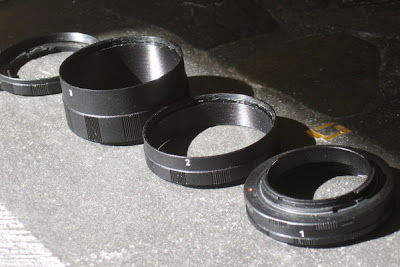
To do this, devices without lenses, which are inserted between the lens and body: the bellows, which provides for removal (and hence magnifications) variables, extension tubes, which have a longer fixed helical extension tube, intermediate between the two: a tube with adjustable length.

I wanted to explore the possibilities of macro without breaking the piggy bank, so I bought a set of extension tubes low end, to see what happens.

  • Type: set extension tubes macro
  • Manufacturer: unknown ( made in China )
  • Purchase Date: August 22, 2007
  • Composition: Adapter Pentax K front and rear, tubular screw (60 × 0.75 mm) No. 1, 2 and 3;
  • Length: 12 to 60mm following composition;
  • Magnification (for a 50mm setting at point at 45cm): 1:0,22 (adapters only) to 1:1,31 (adapters and tubes 1, 2 and 3).

note in passing that the use of macro is to give the magnification on the sensor (the film, in my case). 1:1 means that a 24mm will be the full height of the frame; over the denominator, the more it grows.

What about this game tube? It allowed me to do what I wanted, to discover the macro cheaply. However, the system is screwed tube adapters + malcomode strong, especially as the threads seize up mediocre easily. In short, The settings K adapters, I do not install it on my boxes without fear that they stay there forever ... For further use, it will move to material of better quality.

Tuesday, August 26, 2008

Dune Buggyframe Schematics

SMC Pentax-M 135mm f:3.5

There are photographers who tend to the vast horizons, to the wide-field and others who go instead to the significant detail, to a more close and I'd rather be the latter. So, I tend to alternate between medium and telephoto lens, also without going into very long lenses - regardless of which pose cost problems quickly weight and bulk, not to mention almost need to use a tripod in most situations.

Result: As soon as I can, I bring with me a 135mm. It was part of the paraphernalia of the Spotmatic father and I had bought one as soon as I started to get into the purchase of used equipment: Tamron 135mm f the : 2.8 I told you, very good but a little heavy. I used the earlier 100-300mm zoom sold with the Pentax MZ-10, but he had accumulated a sizeable space with optical quality not above any hint ... The objective

135mm Pentax-M f: 3.5, if my memory is bought at a good ebayers Swiss, is particularly timely complete my collection.

  • Type: Fixed focal lens manual
  • Manufacturer: Pentax
  • Model: SMC Pentax-M 135mm f: 3.5
  • Purchase Date: 19 September 2007 (on ebay, from Switzerland)
  • Filter Holder: 49mm
  • Sunshade integrated
  • Aperture: f/3.5 to 32, eight blades
  • Focus: 1.5m to infinity

The 135mm f: 3.5 M series is above all a marvel of miniaturization: it weighs 270g (according to the site of Bozhidar Dimitrov KMP) is less than 7cm long when you put the point at infinity and has a filter holder for 49mm diameter, so the same wide-angle lenses or average focal length of the series - like the excellent 50mm f: 1.4 I told you about. It also has a small visor integrated practice as any.

result is a goal that I take with me as often as possible in your bag or in her case to him, a little dented - it's a sign that he lived. and I like the images it gives me , for example in combination with films with soft colors such as Fuji or Pro400H Pro800Z: shades of subtle effects of depth of field harmonious ... I still do not separate myself soon.

Sunday, July 20, 2008

Hunting Preserves Moose

SMC Pentax-M 50mm f:1.4

I spoke last week of targets purchased and resold; it, I do not separate. That is what I best, simply.

  • Type: Fixed focal lens manual
  • Manufacturer: Pentax
  • Model: SMC Pentax-M 50mm f: 1.4
  • Purchase Date: September 5, 2007
  • Filter Holder: 49mm
  • Aperture: f/1.4 to 22, eight blades
  • Focus: 45cm to infinity

All accounts, facts, set goals Pentax-M is my favorite . These goals are fully manual (no auto-focus, or control of the diaphragm by the case) very robust and compact - which distinguish them from the previous series (called "Pentax-K, first set of objectives Pentax bayonet), it is precisely their size and low weight to equal optical quality. As a result, much of these goals (28 to 135mm included) have the same diameter filter holder at the front of the lens, 49mm, which is my time convenient.

When you give the reference of any goals, we give two parameters: the focal logueur, which, depending on the size of the sensor (or film component), gives the magnification, and the maximum aperture of the objective, which indicates the maximum amount of light that can capture, aperture wide open. A very large maximum aperture assumes a superior optical quality - after all, with an aperture of pinhole can take good pictures without the use of objectives at all. In short, more objective can open big, it's best - and most expensive, of course.

The amount of light reaching the sensor depends on openness, it also depends on the focal length. To allow comparisons between the values of an optical diaphragm to the other, it expresses these values not in cm or 2 cm but a fraction of the focal length f / 4, f/16, f/5.6 ... In this way, the amount of light reaching the sensor with a diaphragm (say, f: 5.6) is the same regardless of the type of lens used, wide angle or telephoto lens. And exposure time that will result will also be the same. Corollary: As these are fractions, more openness, the greater the value is small. a lens at maximum aperture of f: 2.8 therefore gives a more objective f: 3.5.

Hence the interest of the Pentax f: 1.4: it allows to take pictures even in low light . And, like who can do more can do less, he, at smaller apertures, a fine image much larger than his little friends who are there at the end of the race. Bre: the ideal goal, or not far away.

Monday, July 14, 2008

2010 Littlest Pet Shop Advent Calendar

Bague Tamron Adaptall

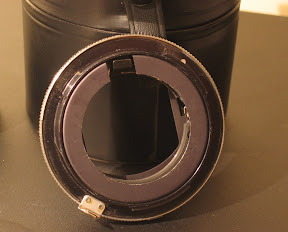
logical complement Tamron Adaptall 28 and 135mm : the adapter ring for my favorite mount, that is, of course, Pentax K mounts

  • Type: ring lens adapter
  • Manufacturer: Tamron
  • Model: Tamron Adaptall Pentax K
  • Purchase Date: August 3, 2007
  • Auction date: November 9, 2007
  • inner frame: Pentax K mount external
  • : Tamron Adaptall

The thing is, since there are boxes on the market with interchangeable lenses, manufacturers have never been able to agree on the interface between body and lens: the frame. Regarding boxes 24 × 36, the only mount shared relatively among many manufacturers is the 42mm screw mount (M42), used by many manufacturers including German, then resumed by Pentax for its first cases (until Spotmatic) and Russian manufacturers, which produced essentially copies of German models .

The problem is that changing a lens with screws, it takes some time - not much, but still ... Hard to do with one hand anyway, even if I changed smoothly M42 goals while walking at a brisk pace through vacant lots in South Africa. Furthermore, when one wishes to connect the camera and lens, for example to indicate to the case that the diaphragm will use it without closing it before the picture is taken, it raises complex engineering problem.

All manufacturers have therefore produced their own beast. Pentax is the K bayonet, a system to lock rotation of 30 ° - a system in which the brand has remained true to this day, unlike its competitors who have striven to render obsolete their own goals Changing Frame (in midstream course). It has been enriched by new functionalities: adjust the diaphragm housing (KA) Autofocus (KAF) ... but still, a Pentax K lens in the early 70's still used on a K20D digital art.

However, the incompatibility between frames manufacturers (except that Ricoh has chosen the K-mount) problem for manufacturers of optical self as Tamron: it was not profitable to produce as many models as manufacturers, even if the optical part remained the same. The solution: produce lenses truncated, with a streamlined frame and offer a broadest range of adapters to be inserted between the lens and body. That's what you see here.

That said, this ring me two problems: first, I had only one to two objectives - the disassembly / assembly of the Adaptall ring is much more tedious than a lens change on the housing . And then it was a ring Adaptall short, so with K-mount, while a ring Adaptall 2 (KA mount) would have allowed me to use these objectives in program mode.

Anyway, I solved the problem: I sold ring and objectives, and bought the same optical Pentax lens!